

The Reversing Valve Dilemma: Why Your Heat Pump Blows Cold During the First Fall Freeze
Facing the First Fall Freeze: Why Is Your Heat Pump Blowing Cold Air?
When that first crisp October morning finally hits, you expect warm air to fill your home, but instead you are faced with The Reversing Valve Dilemma: Why Your Heat Pump Blows Cold During the First Fall Freeze. You walk over to the vents, hold out your hand, and feel a chilling breeze. Immediate panic sets in. Is the system completely broken? Do you need an emergency repair before winter even officially begins? As local HVAC experts, we know how incredibly frustrating it is to switch your thermostat to heat for the first time in months, only to have your home feel like a refrigerator.
Before you assume the worst, it is important to understand the decision point you are currently facing. This sudden burst of cold air could be a temporary hesitation, a completely normal system process, or a true mechanical failure requiring professional intervention. The core component responsible for this seasonal switch is a small but mighty part called the reversing valve. Not every cold breeze means you need immediate help, but knowing what to look for is absolutely essential for your peace of mind.
If you need professional assistance right away, our expert heating services team at ADI Heating & Air Conditioning, LLC is ready to help diagnose and resolve the issue.
Understanding how your HVAC equipment transitions from summer cooling to fall heating can save you a tremendous amount of stress. Heat pumps are unique because they do not generate heat like a traditional gas furnace; instead, they move heat from one place to another. During the summer, they pull heat out of your home. During the fall and winter, they extract ambient heat from the outside air and pump it indoors. The component that makes this dual-functionality possible is the reversing valve, and it carries a heavy workload during the shifting seasons.
Inside the System: How the Reversing Valve Controls Your Comfort
To understand why your system might be blowing cold air, you have to look at the mechanics of the reversing valve itself. This component is a four-way valve installed on the refrigerant line of your heat pump. Inside the brass body of the valve is a sliding mechanism. When you change your thermostat from cooling to heating, an electrical component called a solenoid receives a voltage signal. This solenoid creates an electromagnetic field that physically shifts the slider inside the valve.
How the shift works: By moving the slider, the reversing valve physically reverses the flow of pressurized refrigerant through your system. Instead of the hot, compressed refrigerant flowing to the outdoor coil to release heat, it flows to the indoor coil to release heat into your ductwork. It is a brilliant piece of engineering, but it relies on precise physical movement under extreme pressure.
Over our years of field experience in Gaithersburg, Maryland, our technicians have noticed a fascinating detail that most homeowners do not realize: different heat pump brands handle reversing valve defaults differently.
• Cooling Default Systems: Brands like Trane and Carrier typically design their reversing valves to rest in the cooling position. They require electrical power to shift into heating mode. If the solenoid fails, the system defaults to blowing cold air.
• Heating Default Systems: Brands like Rheem and Ruud design their valves to rest in the heating position. They require power to shift into cooling mode. If the electrical component fails on these units, they will default to blowing warm air.
Because the reversing valve is a sealed mechanical component integrated directly into the highly pressurized refrigerant lines, it is never a DIY fix. Diagnosing a faulty solenoid or replacing a stuck valve requires specialized gauges, refrigerant recovery equipment, and an EPA-certified professional. If you suspect a complete failure, scheduling professional heat pump repair and maintenance is the only safe path forward.
The 15-Minute Rule: Normal Defrost Cycle or Mechanical Failure?
Before you pick up the phone to call for service, you need to know about the defrost cycle. In our daily service calls, we see firsthand how Gaithersburg's rapid temperature swings—where you might experience 70-degree afternoons followed by freezing nights in October—create the exact conditions that trigger sudden defrost cycles. We believe in an honest, educational approach. We want to empower you to wait out a 15-minute cycle rather than immediately spending money on an emergency service call for a system that is working exactly as designed.
When your heat pump operates in heating mode during cold weather, the outdoor coil gets extremely cold—often dropping below freezing. Moisture in the outside air condensates on this freezing coil and turns into frost or solid ice. If this ice builds up, it acts as an insulator, preventing the heat pump from absorbing ambient heat. To protect itself, the system initiates a defrost cycle.
During a defrost cycle, the system temporarily switches the reversing valve back into cooling mode. This sends hot refrigerant to the outdoor coil to melt the ice. Because the system is technically in cooling mode, it will blow cold air from your indoor vents for a short period.
Signs of a Normal Defrost Cycle
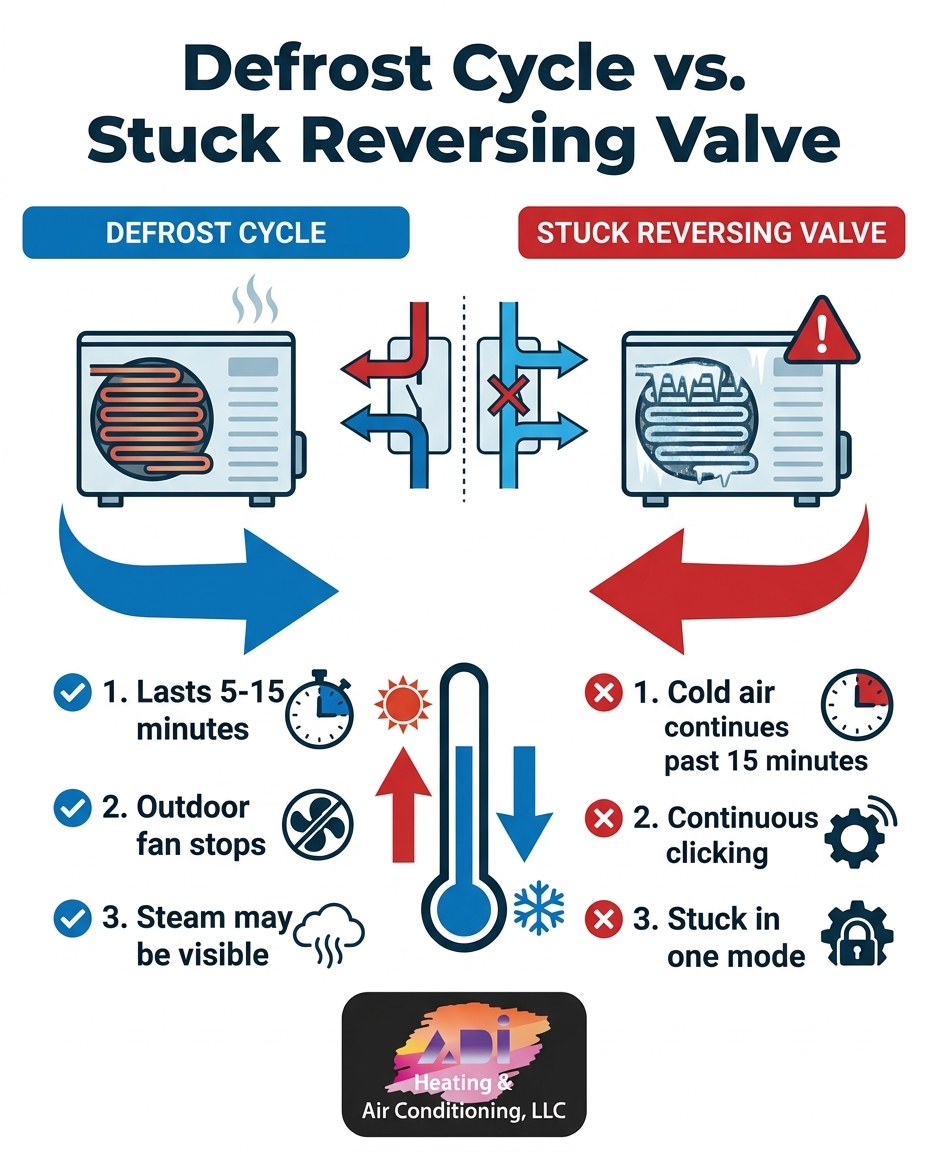
• Temporary cold air: The chilling breeze should last no longer than 5 to 15 minutes.
• Outdoor fan stops: The fan on top of your outdoor unit will stop spinning, but you will still hear the compressor humming loudly.
• Visible steam: You may see a plume of steam or water dripping from the outdoor unit as the ice rapidly melts.
Red Flags of a Stuck Reversing Valve
• Endless cold air: The system continues blowing cold air indefinitely, long past the 15-minute mark.
• Breaker issues: The system repeatedly trips the circuit breaker when trying to switch modes.
• Clicking sounds: You hear a continuous, rapid clicking sound from the outdoor unit, indicating the solenoid is trying to engage but failing.
The Quick Comparison: Use the table below to help determine what your system is experiencing.
• Duration of Cold Air — Normal Defrost Cycle: 5 to 15 minutes maximum — Stuck Reversing Valve: Continuous and unending
• Outdoor Fan Status — Normal Defrost Cycle: Fan stops spinning temporarily — Stuck Reversing Valve: Fan continues spinning normally
• Outdoor Unit Sounds — Normal Defrost Cycle: Loud compressor hum, "whoosh" sound — Stuck Reversing Valve: Rapid clicking or normal operation sounds
• Visual Signs Outside — Normal Defrost Cycle: Steam rising, water pooling under unit — Stuck Reversing Valve: No visible steam or melting ice
Summer Slumber: Why Months of Non-Use Cause Valve Hesitation
If your system passes the 15-minute mark and is still blowing cold air, you might be wondering why a reversing valve would suddenly fail on the very first day you need it. The answer lies in the long, hot summer months. When your system sits in cooling mode from May through September, the physical components inside the reversing valve remain in a static position.
Here is a step-by-step breakdown of what our ADI Heating & Air Conditioning technicians typically uncover when diagnosing these "summer slumber" issues for homeowners in Gaithersburg, Maryland:
1. The Settling of Internal Lubricants: Your heat pump's refrigerant contains specialized oils that lubricate the compressor and the internal slider of the reversing valve. After months of sitting in one position, this lubrication can settle or migrate away from the sliding mechanism, leaving the internal components dry and stiff.
2. The Mechanical Resistance: When the first cold night arrives, the thermostat sends a signal to shift modes. The internal slider, now stiff from lack of movement and lubrication, resists the shift. It physically binds up inside the brass casing.
3. The Solenoid Struggle: The solenoid (the electromagnet) activates, pulling with all its designed force. However, if the mechanical resistance of the dry slider is greater than the magnetic pull of the solenoid, the valve simply will not move. You may hear a click, but the flow of refrigerant remains unchanged.
4. The Incomplete Shift: Sometimes, the valve moves halfway and gets stuck in the middle. When this happens, you will hear a loud hissing noise from the outdoor unit, and the system will fail to heat or cool properly, blowing lukewarm air.
A vital warning: Never attempt physical intervention to free a stuck reversing valve. Hitting the brass casing with a hammer or wrench is incredibly dangerous. The valve is attached to copper lines holding refrigerant under hundreds of pounds of pressure. Striking it can easily cause a catastrophic rupture, leading to severe chemical burns, environmental damage, and a massive repair bill.
Beyond the Valve: Other Reasons Your System Isn't Heating
While the reversing valve is a prime suspect on a crisp October morning, it is not the only reason a heat pump might fail to deliver warm air. Before assuming you have a major mechanical failure, it is wise to check a few simpler components while you wait out the 15-minute defrost window.
Thermostat Miscommunication: Your thermostat is the brain of the operation. If it is malfunctioning, it might fail to send the correct 24-volt signal to the reversing valve solenoid. Sometimes, a dead battery, a loose wire, or an incorrect setting is the only thing standing between you and a warm house. If your screen is blank or unresponsive, you should start by troubleshooting thermostat issues before looking at the outdoor unit.
Severely Restricted Airflow: A clogged, dirty air filter can completely derail your heat pump's performance. When airflow is restricted, the indoor coil cannot transfer heat effectively into your living space. The air coming out of your vents will feel weak and lukewarm, which often feels cold against your skin compared to your body temperature. Check your filter and replace it if it is visibly coated in dust and debris.
Low Refrigerant Levels: A heat pump relies on a very precise charge of refrigerant to absorb and transfer heat. If your system developed a small leak over the summer, it might have had just enough refrigerant to cool the house adequately, but not enough to handle the higher demands of heating. Low refrigerant prevents the system from absorbing heat from the outside air, resulting in cold air blowing from your indoor vents. This requires a professional leak search and recharge.
Proactive Protection: Preparing Your Heat Pump for Winter
Transitioning from reactive troubleshooting to proactive maintenance is the best way to protect your home and your wallet. The sudden shock of the first fall freeze highlights exactly why professional seasonal check-ups are so critical. Testing your heating mode before the severe winter weather hits gives you a buffer to fix any lingering issues without facing an emergency.
During a comprehensive fall maintenance visit, an experienced ADI technician will thoroughly inspect the components that handle the seasonal switch. They will test the voltage reaching the solenoid to ensure the electrical signal is strong. They will manually trigger the reversing valve to ensure the internal slider moves smoothly without binding. They will also verify your refrigerant charge and ensure the defrost control board is operating correctly.
Just recently, a local Gaithersburg homeowner reached out to our ADI Heating & Air Conditioning team for routine maintenance and troubleshooting when their system began acting unpredictably. Our technician arrived promptly, performed a comprehensive diagnostic check, and resolved the underlying issues effectively before the freezing weather set in. This kind of proactive care ensures that small hesitations do not turn into complete breakdowns.
Routine check-ups catch stiff valves before they leave your family freezing. By enrolling in a preventative maintenance plan, you gain the long-term reliability that comes from consistent, professional oversight. Your equipment will run more efficiently, last longer, and provide the dependable comfort you deserve.
Frequently Asked Questions About Heat Pump Reversing Valves
Why is my heat pump blowing cold air instead of heat?
The short answer is that your system may simply be in a temporary defrost cycle to melt ice off the outdoor unit. This is a normal function that protects the equipment from freezing over. However, if the cold air continues, the reversing valve could be stuck in cooling mode, or there may be an issue with the thermostat or low refrigerant levels.
How long does a heat pump stay in defrost mode?
A standard defrost cycle typically lasts between 5 and 15 minutes. During this brief window, the system reverses operation to warm the outdoor coil. Once the outdoor coil is clear of ice and reaches a specific temperature, the system should automatically return to heating mode and begin blowing warm air again.
What are the signs of a bad reversing valve?
If the reversing valve is failing, the system will be permanently stuck in one mode, regardless of how you set the thermostat. You might hear a continuous, rapid clicking sound from the outdoor unit without the mode ever switching. Additionally, the system will struggle to reach your set temperature despite running constantly, often blowing lukewarm or cold air.
Why is my heat pump stuck in cooling mode?
Most commonly, the solenoid that operates the reversing valve has suffered an electrical failure and is no longer creating the magnetic field needed to shift the valve. Alternatively, the physical slider inside the valve might be jammed due to a lack of lubrication after sitting idle all summer. Finally, a faulty thermostat may be failing to send the correct voltage signal to initiate the switch.
Can I fix a stuck reversing valve myself?
No, replacing or repairing a reversing valve requires opening the highly pressurized, sealed refrigerant lines. This is not a DIY project. This complex work must be performed by a licensed HVAC professional who is equipped to handle, recover, and recharge refrigerant safely according to environmental regulations.
Restore Your Home's Warmth with Confidence
Understanding the difference between a normal defrost cycle and a stuck reversing valve brings immediate peace of mind during the first cold snap of the year. When you know what to listen for and how long to wait, you can avoid unnecessary panic and make informed decisions about your home comfort.
While the 15-minute rule can save you from a needless service call, a system that refuses to heat requires prompt attention. Relying on local experts for accurate, honest diagnostics ensures that your equipment is repaired safely and correctly. If your system is failing to produce heat and the cold air just will not stop, do not wait for the true winter freeze to arrive. Schedule a professional inspection today so you can enjoy a warm, comfortable home all season long.
Customer Testimonials